Literary Hotels, journeys through books

In France, there exists a hotel group unlike any other, a cultural and poetic project born from a deep passion: books. In a landscape where hotel chains compete with standardized concepts, the Society of Literary Hotels chose a rare and demanding path: transforming the stay into a literary experience.
Forget impersonal lobbies, anonymous rooms, and impersonal breakfast rooms. In these hotels, every space tells a story, every corridor evokes a work of art, and every room is named after a character. From Paris to Rouen, from Clermont-Ferrand to Nancy, Literary Hotels invite their guests to step into a novel and sleep in the heart of a living library, discovering or rediscovering remarkable authors and their writings.
The story of a family steeped in literature
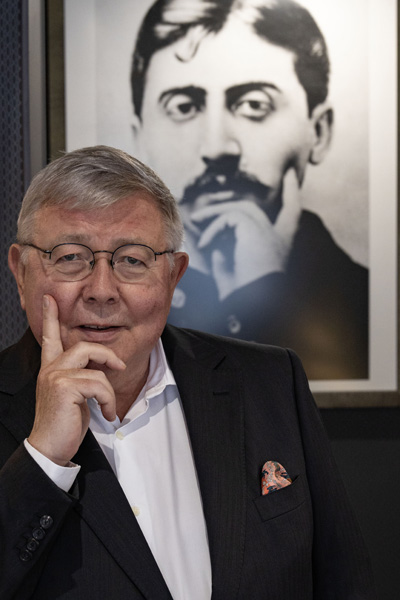
The adventure began with… Jacques LetertreA passionate collector and tireless bibliophile, he saw a book not as an object, but as a world. And he dreamed of sharing this world. When he created the first Literary Hotel, he didn’t expect to give birth to a concept that would become a pioneer in the French cultural landscape: a hotel as a tribute. A tribute to a beloved writer, but also to what reading has to offer at its most intimate: the desire to share.
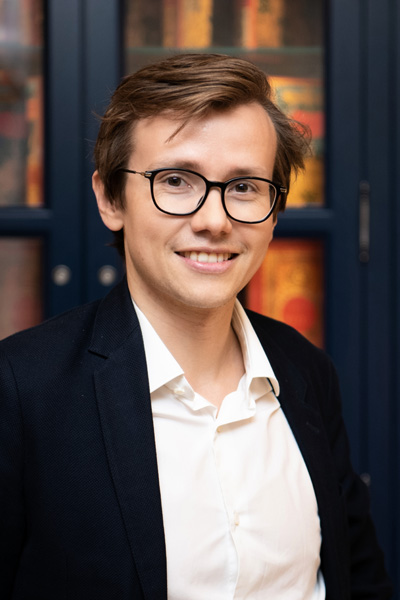
His son Alban Letertre He joined the adventure a few years later. In his own way, he continued his father’s work: modernizing, structuring, committing the brand to sustainable tourism, and obtaining the status of a mission-driven company. The Literary Hotels then became much more than a collection of 4-star establishments: a cultural project in service of French literatureaccessible to all, whether travellers or casual visitors.
A unique concept in France: living in the world of a writer
Literary Hotels share an ambition: to transform a place of transit into a space of culture.
The decoration, designed by the talented Aleth PrimeIt relies on a subtle and immersive scenography. Libraries count over 500 books in several languagesfreely accessible. Manuscripts, works of art, rare editions and historical objects are displayed as in an open museum.
Each room is named after a poem, a character, a place, or a figure from the celebrated author. An original watercolor, an explanatory text, wall quotes, a book on the bedside table… The experience extends to the smallest details.
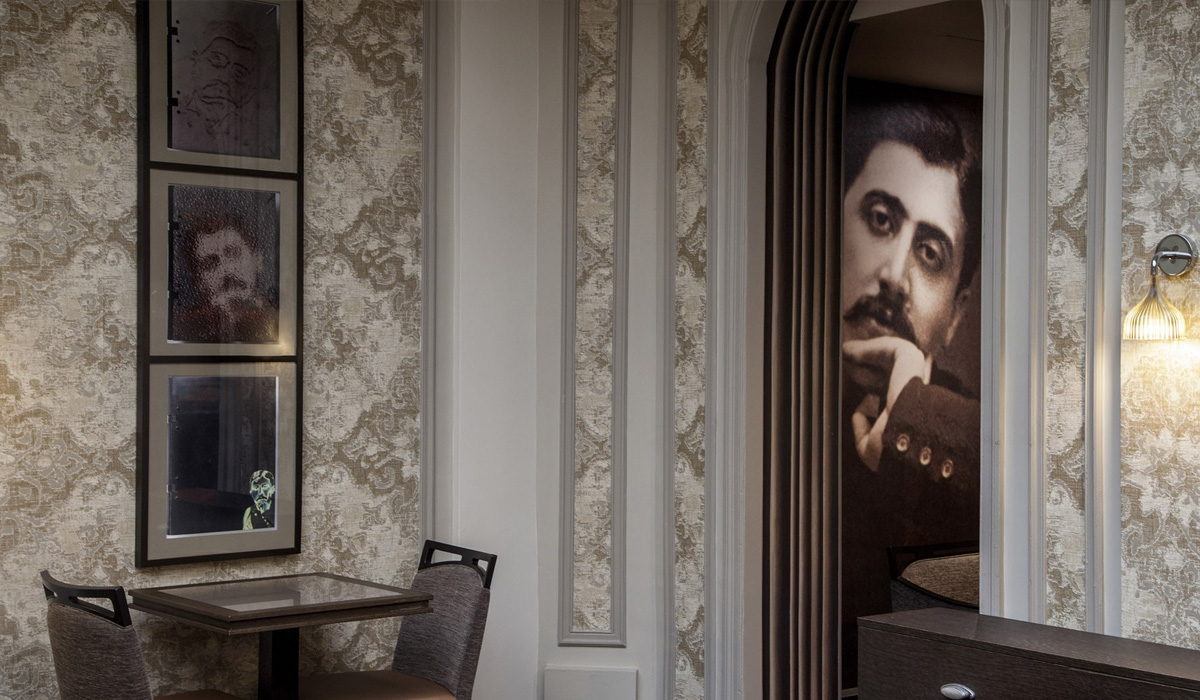
Literary Hotel Le Swann In Paris’ 8th arrondissement: Marcel Proust, the room of time regained
Inaugurated for the centenary of The SwannThe Hôtel Littéraire Le Swann pays homage to Marcel Proust in a hushed and elegant atmosphere, evoking the Belle Époque and the Plaine Monceau district. Built in 1889, the hotel possesses the rare charm of Haussmannian buildings patinated by time. Here, Proust’s magic lantern becomes a decorative motif, the madeleine is savored as a nostalgic reminder, and visitors can follow the routes of Proustian Paris thanks to the historical map designed by specialists of his work.
The Swann is experienced as a journey: that of an author who transformed memory into art. With its 80 individually decorated rooms, its Jacques Guérin lounge, its rare manuscripts and its haute couture pieces designed by Jacques Doucet, it offers Proust lovers a sensitive voyage into the aesthetics of memory.
The Swann This is the first volume of Marcel Proust’s epic novel. The narrator, first as a child and then as a young man, attempts to grasp the movements of memory, desire, and the passage of time. The book opens with a foundational scene: the narrator’s sleepless nights, during which a madeleine dipped in tea evokes a whole forgotten world. This involuntary memory awakens Combray, the village of his childhood, with its walks “towards Méséglise” and “towards Guermantes,” its familiar figures, its rituals, its minute perceptions that will become the very substance of the work.
The second part, entitled “Swann’s Way”, tells the story of Charles Swann’s passion for Odette de Crécy. A story which, from indifference to obsession, shows the power of romantic illusions and the way in which desire transforms the other into a phantom or an idol, according to the projections.
The final section follows the adolescent narrator’s awakening to art, literature, and love, particularly through the figure of a young girl he glimpsed in Balbec, Albertine, who will later become central to the story. Lived time never truly disappears: a taste, a smell, or a moment is enough to rediscover it, intact.
Proust shows that the most innocuous memories possess a revelatory power capable of giving access to the intimate truth of our existence.
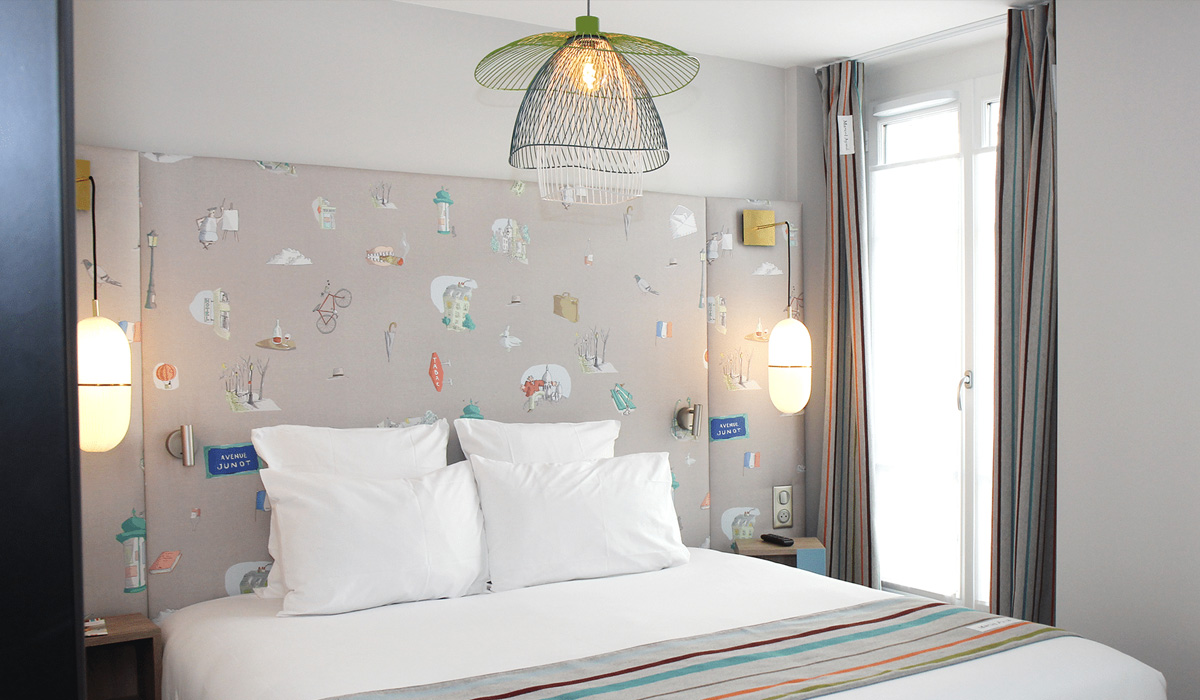
Literary Hotel Marcel Aymé In Montmartre: Following in the Footsteps of the Man Who Could Walk Through Walls
Nestled on rue Tholozé, in the heart of Montmartre, this hotel immerses you in the tender, funny and profoundly humanist world of Marcel Ayme, Author of Wall pass, Tales of the Perched Cat and The Crossing of ParisMontmartre is not a backdrop: it is the very soul of Aymé, who lived here for more than forty years.
Vintage photos, theatre posters, sculptures, reproductions… The hotel captures the spirit of this bohemian Paris of the 1950s. The statue of the Man Who Could Walk Through Walls, which has become iconic, seems to watch over the address.
With its 39 rooms, including a studio and an apartment, it offers a literary immersion full of fantasy and humanity, a warm refuge to rediscover a writer too often associated with his humorous side alone, and yet so subtle.
The Man Who Could Walk Through Walls tells the extraordinary and gently absurd story of Mr. DutilleulA modest employee of the Ministry of Registries. A discreet, shy man, often ignored by his superiors, he leads a perfectly ordinary existence in 1940s Paris… until the day he discovers, by chance, that he possesses an incredible gift: It can pass through walls.
Initially stunned, Dutilleul cautiously tames this ability. Then, emboldened by the injustices of his daily life, he uses it for amusement: he takes revenge on his tyrannical boss, becoming an elusive burglar under the name of Garou-GarouAnd it makes headlines. The power, which he initially wields innocently, gradually gives him confidence, until he falls in love with a married woman, whom he meets every night by passing through the walls of her building. But with repeated abuse, his gift deteriorates: he begins to “stick” to the walls. And one evening, as he attempts yet another escape, his power breaks down at the worst possible moment… leaving him trapped forever in a wall.
The Man Who Could Walk Through Walls is a lighthearted parable about power, freedom, and the illusion that nothing can touch us.
Misused or taken lightly, a gift always ends up backfiring on the one who abuses it.
Marcel Aymé delivers a modern, tender and ironic tale, where the extraordinary reveals the very ordinary flaws of human nature.
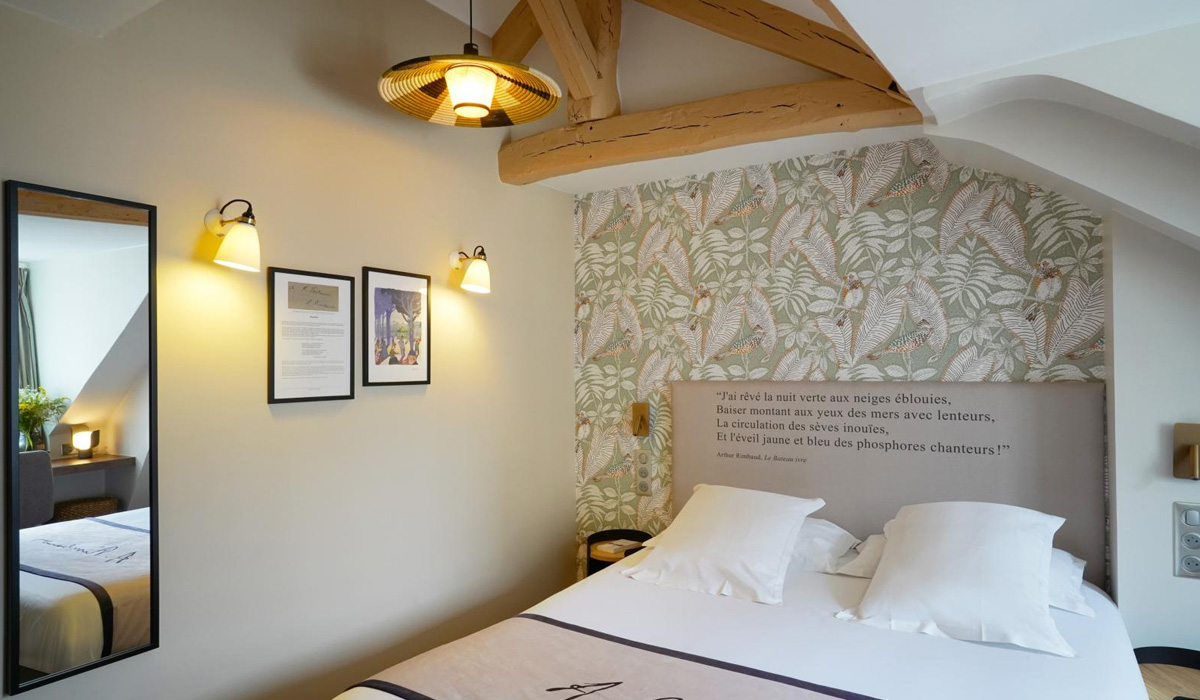
Arthur Rimbaud Literary Hotel In Paris’s 10th arrondissement: the inn of sensory derangement
In this small hotel, “as short as a sonnet,” a stone’s throw from the Gare de l’Est, there is the dazzling poetry of Rimbaud which takes on a life of its own. Each room is dedicated to a poem, illustrated with a vibrant watercolor by Jean Aubertin. The period bar houses an absinthe fountain, a nod to the world of the cursed poets.
A monumental portrait of Ernest Pignon-Ernest greets visitors, while manuscripts and facsimiles remind us that Rimbaud, who left home at the age of 20, revolutionized poetry in just a few short years. For travelers seeking the unusual, it is a rare, vibrant, and unpredictable place, like “the man with soles of wind.”
Rimbaud embodies absolute freedom: to write, then leave, never to be held back by glory, society or by oneself.
The Man with Soles of Wind His nickname, a reminder that some destinies are only lived in motion, recounts a unique trajectory: that of a poet who refused to be confined, even within his own genius. A being whose entire existence was a flight towards the horizon, an attempt to exhaust the world before life exhausted him.
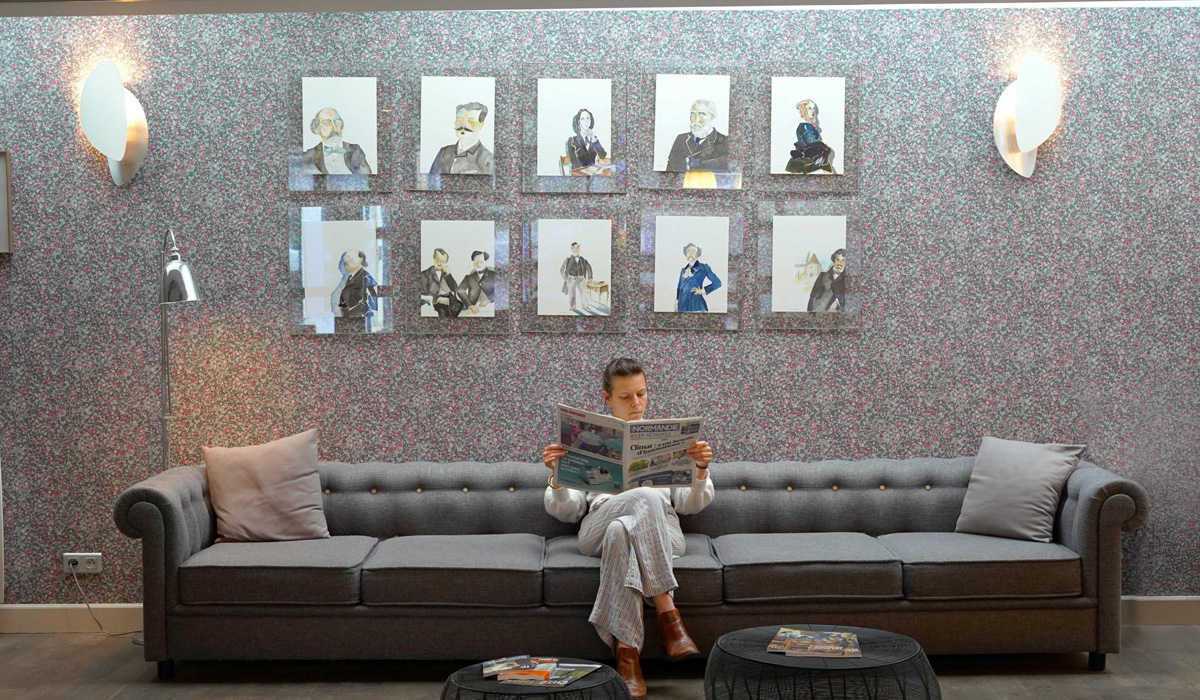
In Rouen, the birthplace of Gustave Flaubert, every street seems to whisper a passage from Madame Bovary, Salammbô ou Sentimental educationThe hotel, located near the Old Market Square, immerses itself in this world.
Here, you can read facing the cage of the parrot Loulou, relax in a boudoir inspired by Emma Bovary or admire monumental contemporary works such as the portrait of Hastaire.
With its 51 personalized rooms, its gentle terrace and its literary afternoon teas, it offers a stay where Flaubert’s flamboyant language becomes decor, atmosphere, living matter.
Madame Bovary It tells the tragic story of Emma, a young woman raised in a convent and married too soon to the kind but dull Charles Bovary, a medical officer. Very quickly, provincial life (around Rouen!) bores her: she dreams of a different world filled with passion, luxury, and grand emotions. Nourished by the romantic novels that shaped her imagination, Emma seeks to escape this existence she considers mediocre.
She first tries to transform her home, then her marriage. But nothing works: reality never lives up to her expectations. Emma then slips into illusion, giving herself over to two affairs, one romantic, the other carnal, which bring her neither happiness nor freedom.
To cope with her disillusionment, she also embarks on a shopping spree, accumulating debt and financial deception. When everything collapses—her loves, her illusions, her finances—she finds herself alone, facing the emptiness of her existence, and chooses poison.
With surgical precision, Flaubert dissects shattered dreams, the weight of social norms, inner isolation, and the cruelty of everyday life. He shows that misunderstood romanticism becomes a trap: that of a life lived not as it is, but as one would like it to be.
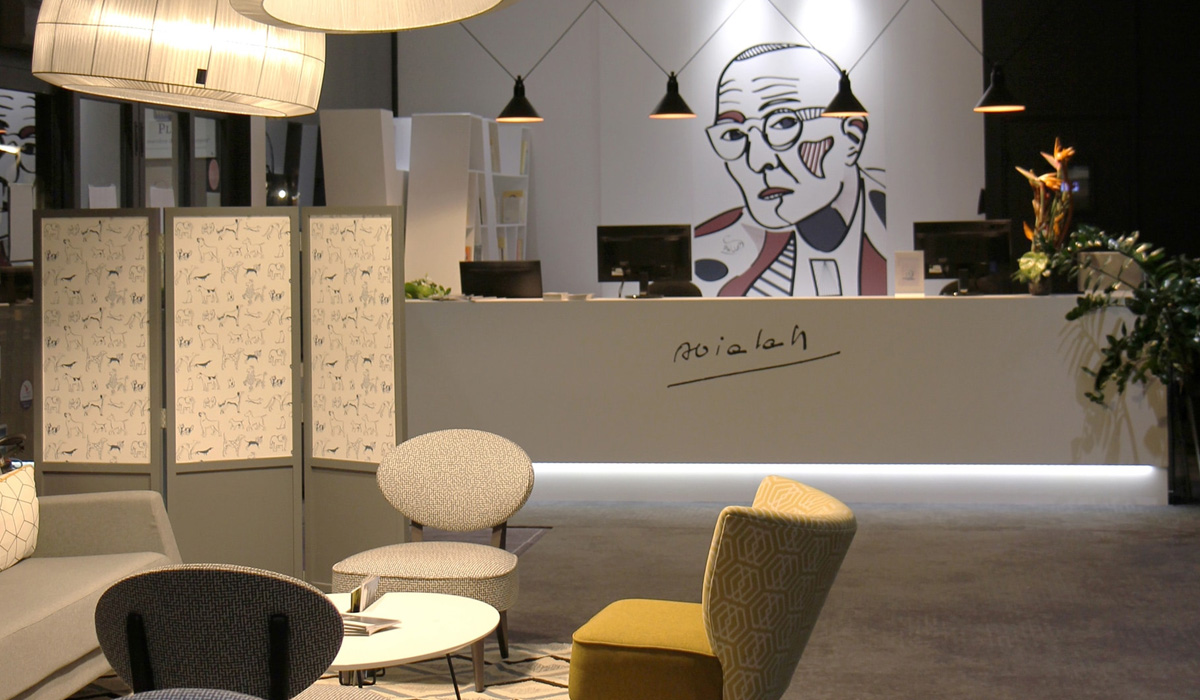
Literary Hotel Alexandre Vialatte In Clermont-Ferrand: a “notoriously unknown” writer finds the light
Alexandre Vialatte, master of the chronicle, unintentional humorist, poet of the everyday, is reborn in this hotel with its Auvergne accents. Located on Place Delille, the establishment overlooks Clermont-Ferrand and offers “the most beautiful view of the city” of the Chaîne des Puys mountain range.
The gilded sculptures from the Fantastic Bestiary by Philippe Kaeppelin, the front pages of The MountainSempé’s sketches bring this unclassifiable writer to life. The hotel also houses vast seminar spaces and a 180 m² coworking bar, making this place an elegant hybrid of culture, work and contemplation.
Vialatte appears there in all his whimsy, his tender irony, his discreet genius.
Alexandre Vialatte’s style is distinguished by a unique blend of understated humor, whimsy, and poetic absurdity. His limpid, musical language transforms everyday details into witty, sometimes surreal, always elegant observations. Beneath this apparent lightness lies a gentle melancholy, a tender yet lucid gaze upon humanity. Vialatte also cultivates the art of the pithy phrase: his ironic punchlines and invented maxims have become legendary. His writing combines joyful erudition with sensitive humor, creating an unclassifiable, brilliant, and instantly recognizable prose.
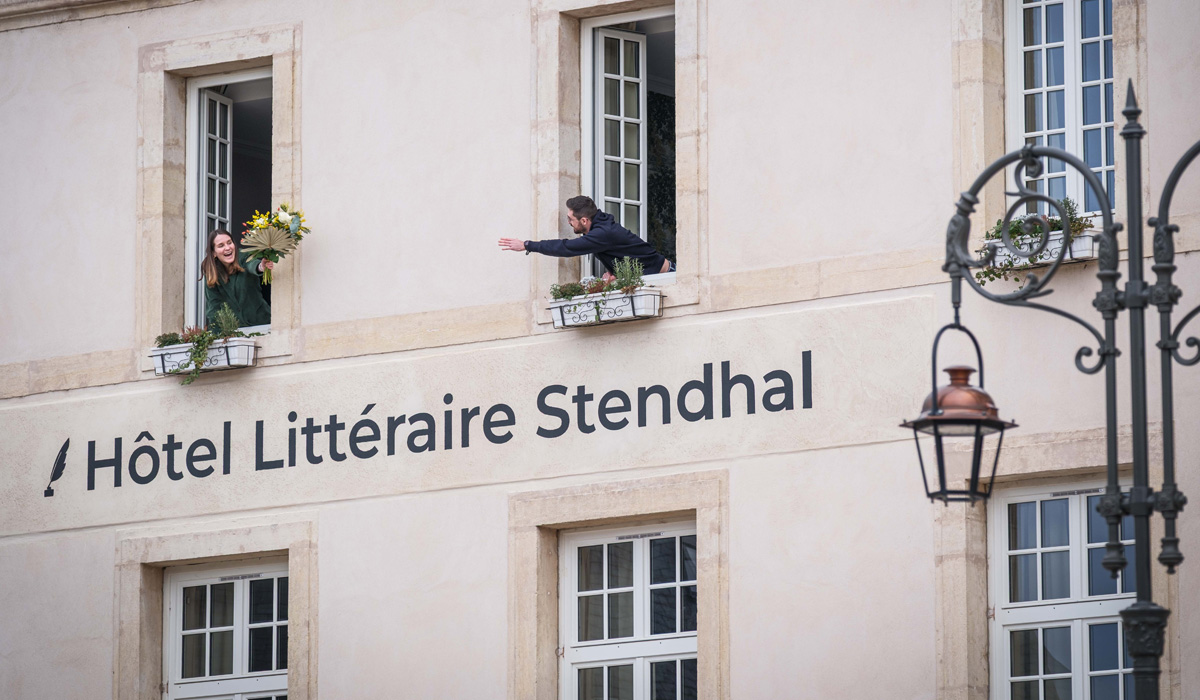
Stendhal Literary Hotel In Nancy: a dreamlike Italy in a 17th-century hotel
The group’s latest addition, the Hôtel Littéraire Stendhal, will open in 2024 in a magnificent building adjoining Nancy Cathedral. It is an architectural gem where each space evokes Italy, music, ardent passions, and Stendhal’s motto: “Vive, Scrisse, Amò”.
The rooms tell a story The Red and the Black, The Chartreuse de Parme ou Lucien LeuwenPart of which takes place in the city. The “Le Rouge et le Noir” spa, bathed in light filtering from the garden, reinvents the art of Italian relaxation. Manuscripts, love letters, Dr. Gagnon’s cabinet of curiosities, and decorations inspired by Italian palaces create a literary journey of great elegance.
The Red and the Black tells the story of the rise and fall of Julien sorelA young man of modest origins, the son of a carpenter in a small provincial town. Ambitious, brilliant, a passionate admirer of Napoleon, he dreams of escaping his background and succeeding in a society dominated by the privileged classes.
Having only two possible paths to climb the social ladder: the army (the red one) ou the Church (the black one). Julien initially chose the clergy, not out of faith but for strategic reasons…
For Stendhal, the quest for social advancement, when based on calculation, pride, and hypocrisy, leads to failure and isolation. Only the truth of feelings offers a form of fulfillment, but it often comes too late.
Literary Hotels don’t just offer rooms: they offer worlds. They don’t sell a night, but a cultural, sensory, intimate experience.
In an era where the hotel industry is searching for new narratives, the Literary Hotels Society demonstrates that an establishment can be a place of culture, transmission and emotion.
Sleeping in these hotels is to reconnect with the pleasure of books, silence, and imagination. It’s to inhabit a chapter, for the duration of a stay.
Ema Lynnx
link