Exploring the nexus between economic growth and tourism demand: the role of sustainable development goals
Descriptive statistics
The descriptive statistics for the six variables—TOUR, SDG, EG, REC, FIN, and EE—show varying degrees of central tendency and distribution characteristics in Table 2. TOUR has a mean of 9.268 and moderate variability (SD = 0.809), with a slight left skew (−0.508) and a near-normal distribution (Kurtosis = 2.600). SDG shows minimal variability (SD = 0.044), a mean of 1.803, and a slightly negative skew (−0.257). EG has a mean of 3.602, with slight positive skew (0.287) and near-normal distribution (Kurtosis = 2.199). REC has high variability (SD = 0.979), a mean of 0.819, and a significant negative skew (−1.151), indicating a long-left tail and peaked distribution (Kurtosis = 4.105). FIN has a mean close to 0, wide range (SD = 1.071), strong positive skew (2.040), and extreme outliers (Kurtosis = 7.337). EE shows low variability (SD = 0.167), a mean of 0.961, slight positive skew (0.205), and a near-normal distribution (Kurtosis = 2.344). These statistics reflect the central tendencies, variability, and distribution shapes of the data.
Correlation analysis
The correlation matrix in Table 3 shows the relationships between six variables: TOUR (Tourism), SDG (Sustainable Development Goals), EG (Economic Growth), REC (Renewable Energy Consumption), FIN (Financial Inclusion), and EE (Energy Efficiency). TOUR is moderately positively correlated with SDG (0.334) and EG (0.496) but negatively correlated with REC (−0.270). SDG shows moderate positive correlations with EG (0.450) and FIN (0.324), while REC is strongly negatively correlated with EG (−0.737) but positively associated with EE (0.305). FIN has weak positive correlations with SDG (0.324) and EG (0.339), but negligible relationships with TOUR (0.062) and EE (0.023). EE demonstrates weak positive correlations with REC (0.305), TOUR (0.122), and SDG (0.155). These findings suggest nuanced interactions between these variables, highlighting areas of synergy and trade-offs, particularly between economic growth, renewable energy, and financial inclusion.
CSD and slope homogeneity test
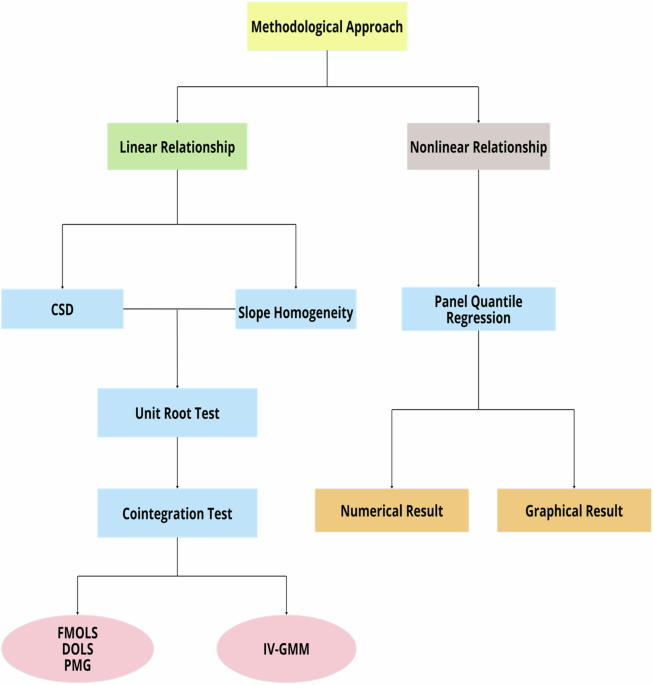
Tables 4 and 5 present the results of the cross-sectional dependence (CSD) test and the slope homogeneity test. The CSD test results strongly indicate the presence of cross-sectional dependence in the panel data, as evidenced by the highly significant p-values (0.0000) across all three tests: the Breusch-Pagan LM test (2847.855), the Pesaran scaled LM test (65.307), and the Pesaran CD test (35.967). The rejection of the null hypothesis at the 1% significance level confirms substantial correlations among residuals across cross-sectional units, underscoring the necessity of employing estimation techniques that account for CSD to avoid biased and inconsistent results. Similarly, the Slope Homogeneity Test reveals significant heterogeneity in the slope coefficients across units. Both the mean-variance bias-adjusted ∆ test (8.349, p-value 0.000) and its HAC-adjusted version (4.564, p-value 0.000) reject the null hypothesis of slope homogeneity. The ∆_adj test and its HAC-adjusted counterpart (10.885 and 5.951, both with p-values of 0.000) further confirm that the slopes vary significantly across units, highlighting the need to account for this heterogeneity in the analysis.
Unit root test
The unit root test results presented in Table 6 indicate that some variables are non-stationary at levels but become stationary at first differences, suggesting they are integrated of order one. Specifically, TOUR and REC exhibit significant stationarity at both the level and first difference across both the Cross-sectionally augmented Im-Pesaran-Shin (CIPS) and Cross-sectional Augmented Dickey-Fuller (CADF) tests, while EG, FIN, and EE are non-stationary at levels but become stationary at first differences. SDG shows mixed results, with significant stationarity at first difference in both tests, although only the CIPS test indicates significance at the level. These findings suggest that all variables are stationary at first difference in both models.
Cointegration test
Table 7 presents the results of four cointegration tests as outlined by Westerlund (2007), which assess the null hypothesis of no cointegration within panel data. The four tests conducted are Gt, Ga, Pt, and Pa. The findings reveal that while the Gt and Ga tests fail to reject the null hypothesis, the Pt and Pa tests do reject it, thereby providing evidence of cointegration. This suggests the presence of a long-term equilibrium relationship between tourism and the specified variables. Consequently, these results confirm that the fundamental assumptions required for estimating cointegration regression are satisfied.
Baseline regression
Table 8 presents the baseline regression results obtained using ordinary least squares (OLS), fixed effects (FE), random effects (RE), feasible generalized least squares (FGLS), and instrumental variable generalized method of moments (IV-GMM) methods. These models allow for a comparative assessment to evaluate the robustness of the findings. Given the presence of endogeneity (Appendix 1b) and dataset heterogeneity (Table 3), the IV-GMM model is selected as the preferred approach due to its ability to address these issues effectively (Acheampong et al., 2020; Acheampong et al., 2021). The absence of heteroskedasticity is confirmed (Appendix 1c). The analysis primarily focuses on the results from the IV-GMM model, as presented in the final column of Table 8.
Before interpreting the IV-GMM coefficients, the model’s reliability is assessed using the LM test and the Wald test. The test statistics, shown in the last three rows of Table 6, confirm that the instrumental variable (IV) is strong, meaning it is neither under-identified nor weak.
The results indicate that economic growth (EG) is positively associated with tourism across all models, suggesting a consistent relationship. Specifically, in the IV-GMM model, the coefficient is 0.771, implying that a 1% increase in EG is associated with a 0.771% increase in tourism. This positive relationship may be attributed to improved economic conditions, increased disposable income, and enhanced infrastructure development, which collectively support tourism expansion (Azam et al., 2021a; 2021b; Shafique et al., 2020). However, causality should be interpreted cautiously, as other factors may also influence tourism growth.
The Sustainable Development Goals (SDG) index exhibits a significant and positive relationship with tourism. A 1% increase in the SDG index is associated with a 2.598% rise in tourism. This relationship may stem from improvements in infrastructure, social services, and environmental sustainability, all of which contribute to making a country a more attractive tourist destination (Ali et al., 2024a). The findings align with previous studies indicating that progress in SDGs enhances tourism potential by improving areas such as transportation, clean energy, and safety (Ali et al., 2024b). However, while the positive link is robust, other external factors may also contribute to tourism growth.
Renewable Energy Consumption (REC) shows a significant and positive relationship with tourism in most models, including the IV-GMM model, where the coefficient is 0.110. This suggests that a 1% increase in REC is associated with a 0.110% increase in tourism. While this relationship appears positive, further investigation is needed to establish whether it is driven by sustainable tourism preferences, energy policy initiatives, or broader economic trends (Azam et al., 2021c).
Financial Inclusion (FIN) exhibits a significant but negative relationship with tourism, with a coefficient of −0.132 in the IV-GMM model. This suggests that a 1% increase in financial inclusion is associated with a 0.132% decrease in tourism. This result may indicate potential financial constraints or instability affecting travel behavior (Ali et al., 2023). However, additional research is necessary to determine whether this relationship is causal or driven by other confounding economic factors.
Finally, energy efficiency (EE) is found to have a significant and positive association with tourism, with a 1% increase in EE corresponding to a 0.562% increase in tourism. This suggests that destinations with improved energy efficiency may attract more tourists, potentially due to lower operational costs for businesses and increased appeal to sustainability-conscious travelers (Ali et al., 2024c). Nonetheless, further research is needed to examine the long-term implications of energy efficiency on tourism demand.
Overall, these findings underscore the interconnected nature of economic, financial, and policy factors in shaping tourism dynamics. While the results provide valuable insights, further investigation is warranted to establish causal relationships and assess potential external influences.
Robustness check
The baseline regression results reveal a positive impact of EG, SDG, and EE on tourism, while FIN exhibits a negative relationship with tourism. To test the robustness of these findings, two robustness checks were conducted.
First, an alternative dependent variable, international tourism expenditures for travel items, was used to represent tourism demand. Table 9 indicates that EG has a positive and significant effect on tourism, with a 1% change in EG associated with a 1.022% increase in TOUR. FIN shows a negative relationship with TOUR, where a 1% change in FIN corresponds to a 0.085% decrease in TOUR. Secondly, an alternative independent variable, specifically GDP (constant 2015 US$), was used to represent economic growth. Table 10 indicates that economic growth has a significant and positive effect on tourism, where a 1% increase in economic growth is associated with a 0.635% increase in tourism. Similarly, SDG and EE also exhibit significant and positive relationships with tourism. A 1% change in SDG is associated with a 4.423% increase in tourism, while a 1% change in EE corresponds to a 0.727% increase in tourism. Conversely, REC demonstrates a significant but negative relationship with tourism, with a 1% change in REC associated with a 0.084% decrease in tourism. It is noteworthy that the coefficients of EG remain significant and positive across all five models, even when alternative dependent and independent variables are applied. This consistency suggests that the relationship between EG and TOUR is robust across different model specifications. Similar findings regarding the relationship between economic growth and tourism have been documented across various countries. Research conducted in India (Suresh & Senthilnathan, 2014), China (Li, Song, & Witt, 2005), Barbados (Lorde et al., 2011), South Korea (Chen & Chiou-Wei, 2009), and Malaysia (Lean & Tang, 2010) highlight a significant relationship between economic growth and tourism. While these studies provide evidence of a positive relationship between economic growth and tourism, it is important to acknowledge that regional and structural differences may influence the strength and nature of this relationship across different economies.
Long run estimation
Table 11 shows the long-run estimation using two models: FMOLS and DOLS. The application of the FMOLS and DOLS models reveals a significant long-term impact of economic growth on tourism demand. Specifically, a 1% increase in economic growth is associated with a 0.83% rise in tourism demand when utilizing the FMOLS model and a 0.56% increase when employing the DOLS model. Additionally, Sustainable Development Goals (SDGs) exhibit a significant and positive relationship with tourism demand, where a 1% improvement in SDG indicators corresponds to a 2.84% increase in tourism demand using the FMOLS model and a 7.66% increase using the DOLS model. Energy efficiency (EE) also demonstrates a significant and positive relationship with tourism demand, with a 1% improvement in energy efficiency leading to a 0.30% increase in tourism demand according to the FMOLS model. However, this variable is omitted in the DOLS model. Other factors, such as renewable energy consumption and financial inclusion, do not exhibit a significant relationship with tourism demand based on the results from both the FMOLS and DOLS models.
PMG/ARDL estimation
Table 12 provides the results of the PMG/Autoregressive Distributed Lag (ARDL) estimation, offering insights into both short-term and long-term relationships among the variables. The analysis indicates a significant positive long-term effect of economic growth on tourism demand, with a 1% increase in economic growth leading to a 1.09% rise in tourism demand over the long run. However, no short-term relationship between economic growth and tourism demand is observed. Sustainable Development Goals (SDGs) exhibit a negative long-term relationship with tourism demand, where a 1% change in SDGs results in a 1.69% decrease in tourism demand. There is also no short-term relationship between SDGs and tourism demand. Renewable energy consumption demonstrates a significant negative relationship with tourism demand in both the short and long term. Specifically, a 1% change in renewable energy consumption leads to a 0.007% decrease in tourism demand in the long run and a 0.708% decrease in the short run. The results from the long-term estimation of economic growth, SDGs, and renewable energy consumption align with the findings from our preferred IV-GMM model, highlighting the robustness of our results.
Asymmetric relationship analysis
After analyzing the linear relationship and identifying a positive correlation between EG and TOUR, we are now keen to investigate the potential existence of a non-linear or asymmetric relationship. To explore this, we utilize the panel quantile regression model (see Table 13) to examine the non-linear effect of EG on TOUR. Panel quantile regression model is instrumental in determining the marginal effect of EG across various quantiles of TOUR. The results of the panel quantile regressions are presented in Table 13 and Fig. 2.

Economic growth and tourism demand
The research reveals a strong and consistent positive relationship between economic growth and tourism demand across various levels of tourism demand (low, mid, and high). This relationship holds true across all quantiles, from the 10th to the 90th percentile, indicating that regardless of the level of tourism demand, economic growth tends to boost tourism. This robustness across quantiles confirms the reliability of the primary finding. The results are consistent with previous studies, such as Po and Huang (2008), who also identified a nonlinear relationship between tourism and economic growth. Similarly, Muhtaseb and Daoud (2017) used nonlinear cointegration tests to find a bidirectional relationship, where not only does economic growth drive tourism demand, but tourism also contributes to economic growth.
SDGs and tourism demand
The study also finds that SDGs have a significant and positive impact on tourism demand, particularly when tourism demand is low. This indicates that as a region or country advances in its SDG performance, tourism demand increases, especially in areas with low tourism activity. The panel quantile regression further shows that at the 10th and 25th quantiles, the relationship between SDGs and tourism demand remains positive and significant. This suggests that even at lower levels of tourism demand, the influence of SDGs is beneficial.
Renewable energy consumption and tourism demand
For renewable energy consumption, a significant and positive relationship with tourism demand is observed, particularly when tourism demand is high. This suggests that regions with higher tourism activity can benefit from increased renewable energy consumption, perhaps due to the appeal of sustainability to environmentally conscious tourists. At higher quantiles (75th and 90th), this positive relationship continues to hold, indicating that renewable energy consumption is beneficial for tourism demand even when it is already at a higher level.
Financial inclusion and tourism demand
The relationship between financial inclusion and tourism demand is significant but negative across all levels of tourism demand (low, mid, high). This finding indicates that increased financial inclusion may not necessarily translate into higher tourism demand and could potentially be a deterrent. This might be due to various factors, such as the availability of alternative financial services that make traditional financial systems less critical for tourists. The negative relationship across all quantiles (10th to 90th) underscores this consistent trend.
Energy efficiency and tourism demand
Energy efficiency has a positive and significant relationship with tourism demand, particularly when tourism demand is moderately low and mid. The panel quantile regression reveals that at the 25th and 75th quantiles, energy efficiency positively impacts tourism demand. This suggests that improving energy efficiency can attract more tourists, likely due to the growing preference for destinations that prioritize sustainability.
The research also emphasizes that the nonlinear results are very similar to the linear results, which further validates the robustness of the primary findings. This consistency across different models and methodologies reinforces the reliability of the relationships identified between tourism demand and the various factors studied. Overall, these findings provide a comprehensive understanding of how different economic, environmental, and social factors interact with tourism demand across various levels, offering valuable insights for policymakers and stakeholders in the tourism and related sectors.
Mediating effects
We employed two mediating variables to denote the effects of export and national income. Consequently, Eqs. 2 and 3 illustrate the impact of exports, as presented in the first and second columns of Table 14, while the impact of national income is shown in the third and fourth columns. Table 14 demonstrates the positive effect of EG on exports. Specifically, a 1% increase in EG corresponds to a 1.041% increase in exports. Furthermore, there is a positive relationship between exports and TOUR, with a 1% increase in export resulting in a 0.757% increase in TOUR. Regarding the second mechanism, there is a significant positive relationship between EG and national income. Specifically, a 1% increase in EG corresponds to a 0.885% increase in national income. Additionally, there is a positive nexus between national income and tourism, with a 1% increase in national income resulting in a 0.565% increase in TOUR. Our research findings align with similar results from other authors. The effects of economic growth on tourism demand are mediated by export effects and national income. Increased exports can enhance a country’s international reputation and attractiveness, thereby attracting more tourists (Eugenio-Martin et al., 2004). For example, the global rise of Korean pop culture, supported by the country’s export strategies, has significantly boosted tourism to South Korea (Kim et al., 2008). Additionally, higher national income increases domestic tourism, as people have more financial resources to spend on travel (Tang & Tan, 2015).
The moderating nexus of SDG
In addition to examining economic growth (EG), we observe a significant direct effect of sustainable development goals (SDG) on tourism (TOUR). The achievement of SDG is crucial for a country’s overall development. As evidenced in Table 8 (baseline regression), Table 9 (regression using an alternative dependent variable), and Table 12 (PMG/ARDL estimation) there is a direct and positive relationship between SDG and TOUR. However, when an alternative independent variable is employed in Table 10, the relationship between SDG and TOUR is also positive.
Table 15 presents the results of the moderation analysis, aligned with Eqs. 2–4, detailed in Columns I, II, and III, respectively. Initially, Column I reveals that both economic growth (EG) and Sustainable Development Goals (SDGs) exhibit a significant and positive impact on tourism demand (TOUR), corroborating earlier findings in the literature.
In subsequent analyses, the interaction terms between EG and SDGs are introduced, revealing a more nuanced relationship. Specifically, the moderation analysis shows that SDGs not only independently contribute to TOUR but also amplify the positive effects of EG on TOUR. This suggests that as economies grow, the presence of strong SDG frameworks further enhances the attractiveness of tourist destinations, beyond what economic growth alone would achieve.
This positive moderation effect can be attributed to several factors. First, SDGs encourage sustainable practices that lead to the preservation of natural and cultural assets, which are key attractions for tourists. For instance, stringent environmental regulations (under SDG 12) ensure the conservation of landscapes and ecosystems, which are vital for eco-tourism. Similarly, efforts to build sustainable cities (SDG 11) contribute to safer, cleaner, and more culturally vibrant urban spaces, increasing their appeal to visitors.
Moreover, the promotion of “decent work” (SDG 8) within the tourism and hospitality sectors can improve service quality, leading to better tourist experience and higher satisfaction rates. This, in turn, creates a positive feedback loop where high-quality services attract more tourists, driving further economic growth and investment in the tourism sector. The interaction effect between EG and SDGs also implies that sustainable development practices are not just supplementary but integral to maximizing the benefits of economic growth in the tourism industry. By embedding sustainability into the core growth strategy, destinations can ensure that economic gains are durable and inclusive, leading to a more resilient tourism industry that can withstand economic downturns or environmental challenges. Furthermore, this integrated approach fosters a competitive advantage for destinations that prioritize SDGs, as they can market themselves as environmentally conscious and socially responsible, attracting a growing segment of tourists who value sustainability. This differentiation in the market can lead to increased tourism revenue and long-term economic prosperity.
The moderation effect of SDGs on the relationship between economic growth and tourism underscores the importance of aligning growth strategies with sustainable development goals. This alignment not only enhances the immediate economic benefits of tourism but also ensures that these benefits are sustained over the long term, contributing to a more robust and resilient tourism industry.
link