


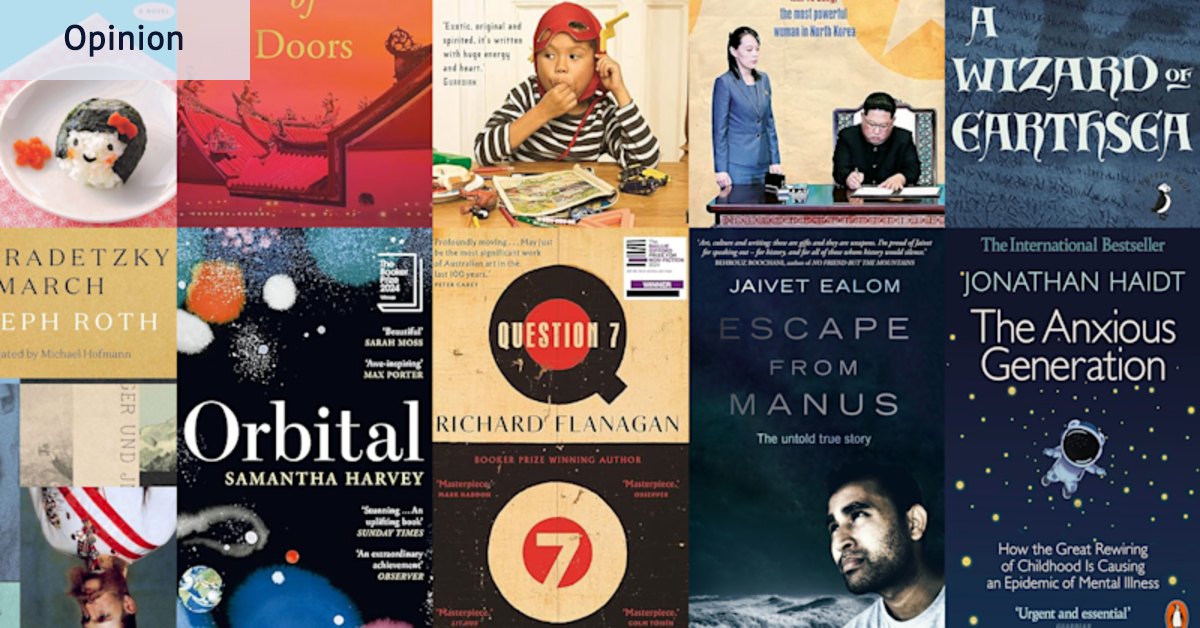
Thank goodness for great writers such as Chimamanda Ngozi Adichie. Her collection, The Thing Around Your Neck, landed me in short stories from Nigeria, but many will know her as a powerhouse who roams across national borders. One story, about an arranged marriage, was even better on a second reading. The recent news about the death of her son is heartbreaking.
I experimented with stories from worlds that were invented or no longer existed. One was The Wizard of Earthsea, by Ursula Le Guin. The other was The Radetzky March, by Joseph Roth, set during the collapse of the Austro-Hungarian Empire.
Another book from a different world was Orbital, by Samantha Harvey, set on the international space station. This was light on plot and heavy on description, more like a long poem than a short novel. Intriguing, but not fully satisfying.
Returning to Australia, at least for a short while, I was glad I chose Question 7, by Richard Flanagan, a meditative memoir. Another book was impossible to label with a single country: Escape From Manus, by Jaivet Ealom, a Rohingya refugee, moved rapidly from Myanmar to Papua New Guinea and beyond. He assumed a false identity to escape, and it is a fascinating tale.
I know the target of 52 books can seem unserious, almost like a contest we should grow out of after school. In fact, it has two great qualities. First, it makes movement essential: you change landscapes and characters with each new title. Second, it forces risk: there can be a sameness to the stories from your own country, and there is a lot to be said for leaping out of your comfort zone.
Loading
There was not much comfort in my visit to Albania in Broken April, by Ismael Kaldare, a bleak novel of a blood feud. Nor in the killing fields of Cambodia, in Surviving Year Zero, by Savonnora Ieng, a clear account of an ugly history. And not in Some People Need Killing, by journalist Patricia Evangelista, about political murder in the Philippines.
I had time for only a single title from the US, something of a travesty, but at least I chose well: The Anxious Generation, by Jonathan Haidt, is an essential analysis of children and mental health in the iPhone era.
I was engrossed in Caledonian Road, by Scottish author Andrew O’Hagan, who brought the modern class structure alive in a big story that ranged across elite and squalid London.
Then I was off to the valleys of Wales in The Life of Rebecca Jones, by Angharad Price. This short novel was a wonderful discovery for the way it evoked village life over generations. Soon afterwards I was in Ireland (and elsewhere) in Barcelona, a brilliant collection of short stories by Mary Costello.
The more I read, the more sceptical I became about prizes for global fiction. I’ve had mixed success with the recent winners of The International Booker Prize, but I’ve loved some that did not even make the shortlist. Lost On Me, by Veronica Raimo, was one example. It did what so many cover blurbs promise but not enough books deliver: made me laugh out loud.
What stood out were the books that offered insight into the world as it is.
One of the best books of these 52 fortnights also missed out on the Booker. This was Lullaby, by Leila Slimani – an unsettling and absorbing account of a Moroccan nanny in Paris. It should have won in 2023.
What stood out were the books that offered insight into the world as it is, not always as we would like it to be.
One was The Death of a Soldier Told by His Sister, by Olesya Khromeychuk, a story of the war in Ukraine, and a family from Lviv, that avoided false heroics. Another was Necropolis, by Boris Pahor, a Slovenian writer who took me into parts of the Holocaust I had not known. When the year ended with the horror of the Bondi attack, it seemed to me even more necessary to read and remember the accounts that show where hatred leads.
Loading
Without a target, I might not have read Born A Crime, by Trevor Noah, who used to host The Daily Show. His memoir of growing up in South Africa is funny and thoughtful, which is why it has sold by the millions. The star of the tale is his mother, who made him go to church three times on Sundays.
Without a deadline, I would not have picked up a very, very short book to race through Denmark. This was The Emperor’s New Clothes, by Hans Christian Andersen, a tale we all know but can all read again. It skewers political vanity with a smile – and we all know the modern ruler who wears the same old fashion.
The best of the books? Looking back, I think of Homegoing, by Ghanaian-American writer Yaa Gyasi, as the perfect reason to read fiction. It took me somewhere I had never been, it brought characters alive, and it did this with light but perceptive prose. It’s the kind of book you give to friends in the hope they will love it, too.
Thank you for reading and subscribing. I wish you the best for the year ahead. We cannot be sure where the world is heading, so it might help to get lost in a good book.
52 books from 52 countries in 52 fortnights*
Nathacha Appanah, The Last Brother, Mauritius, 2007
Ayaan Hirsi Ali, Nomad, Somalia / Holland / USA, 2010
Joseph Roth, The Radetzky March, Austro-Hungarian Empire, 1932
Ursula le Guin, The Wizard of Earthsea, US / Earthsea, 1968
Hila Blum, How to Love Your Daughter, Israel, 2023
Margaret Atwood, Surfacing, Canada, 1972
Sallust, The Conspiracy of Cataline, Rome, 40BC
Jaivet Ealom, Escape From Manus, Myanmar / Australia / PNG / Canada, 2021
Patricia Evangelista, Some People Need Killing, The Philippines, 2023.
Murong Xuecon, Deadly Quiet City, China, 2022
Faysal Khartash, Roundabout of Death, Syria, 2017
Leo Vardiashvili, Hard By A Great Forest, Georgia, 2023
Eleanor Catton, Burnam Wood, New Zealand, 2023
Olga Tokarczuk, Flights, Poland, 2007
Jonathan Haidt, The Anxious Generation, USA, 2024
Ramita Navai, City of Lies, Iran, 2014
Kapka Kassabova, Border, Bulgaria, 2017
Ia Genberg, The Details, Sweden, 2022
Anna Funder, Wifedom, Australia, 2023
Soname Yangchen, Child of Tibet, Tibet / UK, 2006
Junot Diaz, The Brief Wondrous Life of Oscar Wao, Santo Domingo, 2007
Hisham Matar, In The Country of Men, Libya, 2006
Nilima Rao, A Disappearance in Fiji, Australia / Fiji, 2023
Savannora Ieng, Surviving Year Zero, Cambodia, 2014
Yaa Gyasi, Homegoing, Ghana, 2016
Tan Twan Eng, The House of Doors, Malaysia, 2023
Leila Slimani, Lullaby, Morocco / France, 2018
Sung-Yoon Lee, The Sister, North Korea, 2023
Andrew O’Hagan, Caledonian Road, UK, 2024
Jenny Erpenbeck, Kairos, Germany, 2023
Willem Frederik Hermans, An Untouched House, The Netherlands, 1951
Thomas Bernhard, The Rest Is Slander, Austria, 2022
Angharad Price, The Life of Rebecca Jones, Wales, 2002
Veronica Raimo, Lost On Me, Italy, 2022
Hans Christian Andersen, The Emperor’s New Clothes, Denmark, 1837
Fred Charles Ikle, Every War Must End, Switzerland / US, 1971
Fyodor Dostoevsky, Notes From Underground, Russia, 1864
Oliver Lovrenski, Back In The Day, Norway, 2023
Ismael Kadare, Broken April, Albania, 1978
Georges Simenon, The Man From London, Belgium, 1934
Mary Costello, Barcelona, Ireland, 2024
Milan Kundera, 89 Words and Prague, A Disappearing Poem, Czechia, 2025
Richard Flanagan, Question 7, Australia, 2023
Sayaka Murata, Convenience Store Woman, Japan, 2016
David Diop, At Night All Blood Is Black, Senegal, 2018
Antal Szerb, Oliver VII, Hungary, 1942
Esther Garcia Llovet, Spanish Beauty, Spain, 2025
Chimamanda Ngozi Adichie, That Thing Around Your Neck, Nigeria, 2009
Ngugi wa Thiongo, The Perfect Nine, Kenya, 2020
Boris Pahor, Necropolis, Slovenia / Italy, 1967
Raja Shehadeh, Palestinian Walks, 2007, Palestine
Trevor Noah, Born a Crime, South Africa, 2016
Olesya Khromeychuk, The Death of a Soldier Told by His Sister, Ukraine, 2021
Jean Giono, The Man Who Planted Trees, France, 1953
Samantha Harvey, Orbital, UK and Low Earth Orbit, 2023
Olga Ravn, The Employees, Denmark, 2018
* The list has 56 books, which reflects my indecision at times. It has two from Australia: Question 7, by Richard Flanagan, and Wifedom, by Anna Funder. It has two authors from Denmark: Hans Christian Andersen, but also Olga Ravn. This was because counting The Emperor’s New Clothes as a book felt like cheating. There are two from the US, also, because Fred Charles Ikle was born in Switzerland but spent most of his life in the US. I include his book, Every War Must End, because it is so good.
David Crowe is Europe correspondent for The Sydney Morning Herald and The Age.
The Booklist is a weekly newsletter for book lovers from Jason Steger. Get it delivered every Friday.
link